Which Region in Spain Has the Lowest Taxes?
You've decided to move to Spain. The culture, the climate, the quality of life—all excellent reasons. However, before addressing the paperwork, one must first address the main financial question: "How much tax will I pay, and how does my region affect that amount?"
Spain doesn't have a single, uniform tax system. The central government (the State) sets the foundation, but the 17 autonomous communities (regions) have the power to adjust and reduce key taxes on income, wealth, and property transfers. The data is clear: your postcode directly dictates your financial liability.
Income Tax Rates in Spain (IRPF) and Spain Income Tax Brackets by Region
The Personal Income Tax (IRPF) applies to the worldwide income of residents. The total rate comprises two parts: a state component and a regional (autonomous community) element. While the regional portion often accounts for around half of the total, the exact breakdown varies by income bracket and community. The state's rates are uniform across Spain, but each region sets its own regional scale, so your overall tax rate depends on where you live.
How Do Spain Income Tax Rates Differ for High Earners Across Autonomous Communities
When looking at Spain's income tax brackets, the differences between regions are particularly significant for those in the upper levels.
- Lowest Top Rate (Most Favourable): The Community of Madrid maintains one of the lowest regional rates. For high-income earners, the combined total top marginal rate remains around 45% (State + Regional).
- Highest Top Rates (Least Favourable): Regions like the Valencian Community and Catalonia apply higher regional rates. In Valencia, the top marginal rate can be as high as 54%. Catalonia's top rate reaches 50%. Navarre, with its distinct fiscal regime, also features high progressive rates near 52% at the top end.
Practical Scenario: For a resident with an income over €300,000, the difference between the most and least favourable regions can exceed 9% on the top marginal rate.
Wealth Tax in Spain: Understanding Patrimonio and Spain Wealth Tax by Region
The Wealth Tax in Spain (Impuesto sobre el Patrimonio) is an annual tax on net worldwide assets for residents above regional/national thresholds. Autonomous communities control the regional treatment and exemptions of Patrimonio, resulting in significant variations in liability and effective rates across regions.
Spain Wealth Tax by Region
The Spanish State's Temporary Solidarity Tax on Large Fortunes (Impuesto Temporal de Solidaridad de las Grandes Fortunas), commonly known as ISGF, remains applicable to net wealth exceeding €3 million (according to recent measures), regardless of regional relief.

The determination of Wealth Tax in Spain is primarily decided by the Autonomous Communities, which has led to significant divergence in liability, with some regions offering 100% relief.
For those wondering which Spanish regions have no wealth tax, it is worth knowing that several regions, such as Madrid, Cantabria, Extremadura, Andalucía, Murcia, and La Rioja, in recent years, offer full regional relief from the Patrimonio tax, effectively eliminating the regional Patrimonio bill for qualifying residents. However, 'no regional Patrimonio tax' does not automatically mean 'no wealth tax at all', as the national ISGF may still apply to extremely high net wealth.
Note: if your net wealth is below the €3 million solidarity tax threshold, then in the regions offering 100% relief (such as Madrid and Andalusia), you will pay €0 in wealth tax.
The Most Significant Variable: Inheritance Tax in Spain
The Inheritance and Gift Tax (Impuesto sobre Sucesiones y Donaciones) is levied on the recipient (the heir). This tax shows the most significant variation, with the final bill for close family members ranging from negligible to substantial.
Near-Zero Tax Regions (99%+ Relief for Groups I & II)
These regions offer near-total relief for close family (Spouse, children, parents).
- Madrid, Andalucía, Murcia, Cantabria, Galicia, La Rioja, the Valencian Community, and Castilla-La Mancha all offer a generous 99% reduction for Group I/II relatives.
- Andalucía has offered generous allowances in some recent reforms. Certain measures provide large tax-free allowances for close relatives under specified conditions.
- The Canary Islands offer a 99.9% reduction.
Higher Tax Regions (Fewer Reductions)
- Asturias maintains low state allowances, resulting in a significantly higher inheritance tax burden.
- Catalonia offers some fixed allowances (for example, the €100,000 reduction for children over 21), but the effective tax rates are substantially higher than the 99% relief regions.
Note: Groups I & II refer to the level of relationship to the deceased (kinship groups).
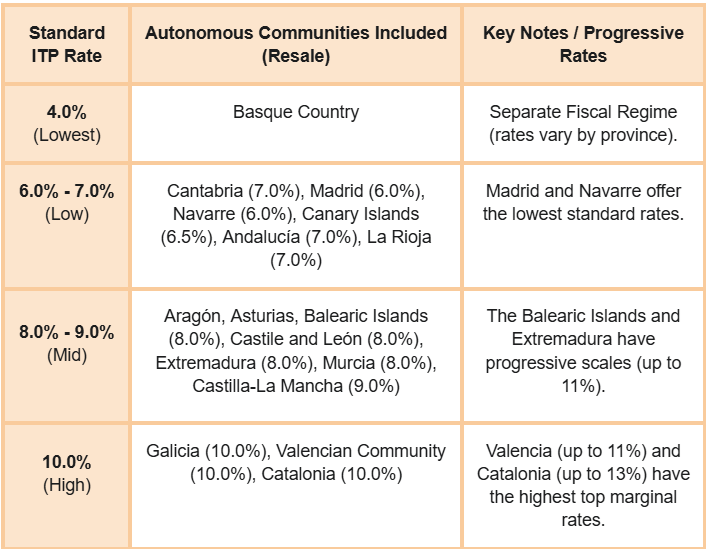
Property Acquisition: Property Transfer Tax (ITP)
The Property Transfer Tax (ITP) is a one-time charge paid by the buyer of a resale property. The rate is set regionally and applied to the property’s price or reference value.
Tax Rates in Spain Across 17 Regions
Overview & FAQ: Essential Questions on Income Taxes in Spain and Residency"
Which Region in Spain Has the Lowest Taxes?
Based on the combined impact on income, wealth, and inheritance, the Community of Madrid consistently ranks as the most tax-competitive region. Andalucía is also highly competitive, particularly on wealth and inheritance
What Are the Different Types of Taxes in Spain?
A: Key taxes include the Personal Income Tax (IRPF), Corporate Tax (IS), Wealth Tax, Inheritance and Gift Tax (ISD), and the Property Transfer Tax (ITP) or VAT/Stamp Duty for new properties.
Checklist for Strategic Residency:
- Define Tax Residence: Confirm you will spend more than 183 days in your chosen region.
- Model Your Income: Use current regional tables to project your annual IRPF liability.
- Review Estate Plan: Ensure the regional rules for Inheritance Tax in Spain are factored into your Spanish will.
- Budget for Acquisition: Confirm the exact regional ITP or Stamp Duty rate before purchasing property.
Conclusion
Effective tax planning services can leverage tax differences between regions, resulting in significant savings in certain autonomous communities. Some regions offer more comprehensive assistance with Wealth Tax (Patrimonio), while others have more favourable Personal Income Tax (IRPF) deals, so it is important to be precise and adapt your approach to the circumstances. Consulting a chartered tax advisor will help you to make the most of these and other special tax benefits while ensuring full compliance with Spanish law.
At Tytle, we provide global tax services, including:
- Accounting/bookkeeping
- Accurate tax filing
- Estate planning
- Cross-border advice
- Immigration services
- And much more!
For more international tax advice, feel free to explore: “Retiring in Spain: Clock Ticking on Tax Perks?” and “How to Get a Tax Identification Number in Spain (NIF)? A Guide for Expats and New Residents”.
This content is for informational purposes only and does not constitute tax, legal, or financial advice. Tax laws change frequently and vary by jurisdiction. Consult a qualified tax professional for advice specific to your situation.